Why Do Galleries Have Waiting Lists for Emerging Artists' Work?

Updated: Sep 27

Galleries keep waiting lists for an emerging artist's work when more art collectors want it than the artist produces at the gallery's set price. Rather than raise that price until demand clears, the gallery rations supply: it decides who is offered each new work, generally favouring collectors expected to hold it, lend it or give it to a museum over those likely to resell quickly.
The assumption worth complicating is that a waiting list is a measurement — a reading of demand, where a longer list means a stronger market and a place on it is a claim on a future investment. A waiting list is closer to an instrument than a measurement: a private document kept by the party selling the work, never published and never audited, built around a decision the gallery has already taken, which is that price will not be the thing that decides who receives the painting. That decision governs everything an art collector can infer from the list, including whether it says anything about the market at all.
A Price Set in Advance, Not Discovered
Primary-market prices for emerging artists are administered rather than discovered: an administered price is one a seller sets and holds, as opposed to one that moves with each transaction the way an auction result does. The gallery fixes a figure by size and medium, usually in consultation with the artist, and keeps it steady across an exhibition, a fair and the months in between. When more collectors want the work than the studio can supply at that figure, the surplus of demand has nowhere to go in the price itself, so it collects instead as a queue. A waiting list is less a separate institution than the visible residue of a fixed price meeting excess demand.
Çiğdem Aky illustrates the structure a list sits inside, with no suggestion that one exists for her. Dirimart places the Düsseldorf-based painter under its represented artists, and its listings for her artworks invites collectors to request price and availability rather than stating a figure. No auction result with a disclosed price has surfaced for her work, so the gallery's number is the only one in circulation. That is the ordinary condition for a painter at her stage: it is precisely the condition under which a gallery, not a bidding room, decides who receives the next canvas. Whether any queue has formed behind that figure is not public information, and a collector should not expect it to be.
Why Not Simply Raise the Price?
The textbook answer to a queue is a higher price, and galleries resist it for reasons closer to risk management than to generosity: the cost of a price that proves too high is far larger than the cost of one that proves too low. Gallery prices for living artists behave as though they move in one direction only: a figure that has been raised is difficult to lower without signalling to every existing collector that the work they already own is now worth less, so a dealer who overshoots has no graceful way back. Collectors in that position tend to be loss-averse, meaning they feel a paper loss on a work they own more sharply than an equivalent gain, and a visible price cut could unsettle an entire client base at once. Holding the price below the level demand would bear keeps a margin of safety in reserve, much as a prudent borrower leaves headroom beneath a lender's limit rather than drawing down to the last pound.
There is a second reason, specific to emerging careers: the first public test. A primary price that runs far ahead of what collectors would pay elsewhere invites the first auction appearance to disappoint, and an early result below the gallery figure would be read, fairly or not, as a verdict on the artist. As Tim Schneider argued in 2017, the list also does commercial work of its own: its existence tells each collector that someone else stands ready to take any work they decline, which supports both the sale and the price. The queue is the cost of that caution. The gallery accepts it deliberately.
Who Is Offered the Next Artwork?
A waiting list sounds like a line in which position is set by arrival: in practice it rarely works that way. The closer analogy is the allocation of shares in a new stock-market listing, where the banks running the offering hand the most sought-after stock not to whoever asked first but to the investors they expect to hold it — long-term funds rather than traders likely to sell on the first day. Galleries apply a comparable filter to contemporary art: the question is less who asked earliest than whose collection the work would strengthen, whether that collector lends to exhibitions or is likely to give work to a museum, and whether they have resold primary-market purchases before.
Schneider's account makes the same point from inside the trade: a collector with a stronger reputation can be moved ahead of someone who has waited longer, which makes the list a ranking rather than a chronology. The practical consequence is that a place on it works as a credential check as much as a reservation. A collector new to a gallery can reasonably expect to be offered smaller or less central works first, and to reach the most sought-after pieces only after building a record of keeping what was bought.
A waiting list does not record how much the market wants an artist's work. It records which collectors the gallery has decided should have it, and what each of them has agreed not to do next.
The Resale Clause That Arrives With the Allocation
An allocation usually comes with conditions, and this is where the list stops being a courtesy and starts carrying a cost. In June 2023, resale restrictions had become routine in gallery sales contracts, typically barring resale for three to five years and requiring the collector to offer the work back first: a right of first refusal, meaning the gallery may match any offer the collector receives before the work can go elsewhere. The same report records a New York art lawyer's view that jumping a waiting list, or gaining priority access to limited supply, is itself the value a collector receives in exchange for accepting those limits. The place in the queue is, in effect, what the collector is paid in.
Whether such clauses would survive a court remains unsettled: no English court has yet been asked. Phillips's chief general counsel Martin Wilson has argued, that many would fail the fairness test under English consumer law, while other lawyers take the opposite view and case law is thin on both sides of the Atlantic. The more reliable enforcement appears to be informal, resting on the prospect of a collector losing access to a gallery's programme altogether rather than on litigation. For the collector the financial effect is similar either way: the work becomes less liquid, meaning harder to convert into cash quickly without accepting a lower price, for the length of the restriction, and the gallery keeps a say over whether and where any future public price test takes place. What those terms commit a collector to, and when they bind, is set out in Can You Resell Art You Bought From a Gallery?
Does Every Gallery Artist Have a Queue?
Most do not: the more common task for a gallery working with an emerging artist is finding collectors rather than rationing them. The Art Basel and UBS Art Market Report 2026 found that the average number of unique buyers per dealer fell to 57 across the full year 2025, the lowest level since 2021, with the steepest fall, of 40%, among the smallest businesses, where the average dropped to 29. The same survey found that 60% of those smallest dealers' clients in 2025 were new to the business. Those figures describe galleries whose central problem is widening a client base, which is the opposite of the problem a waiting list solves. Reporting on the previous year's edition, The Art Newspaper carried dealers' accounts of the same shift: competition for work in artists' studios had given way to demand concentrated on names collectors already knew.
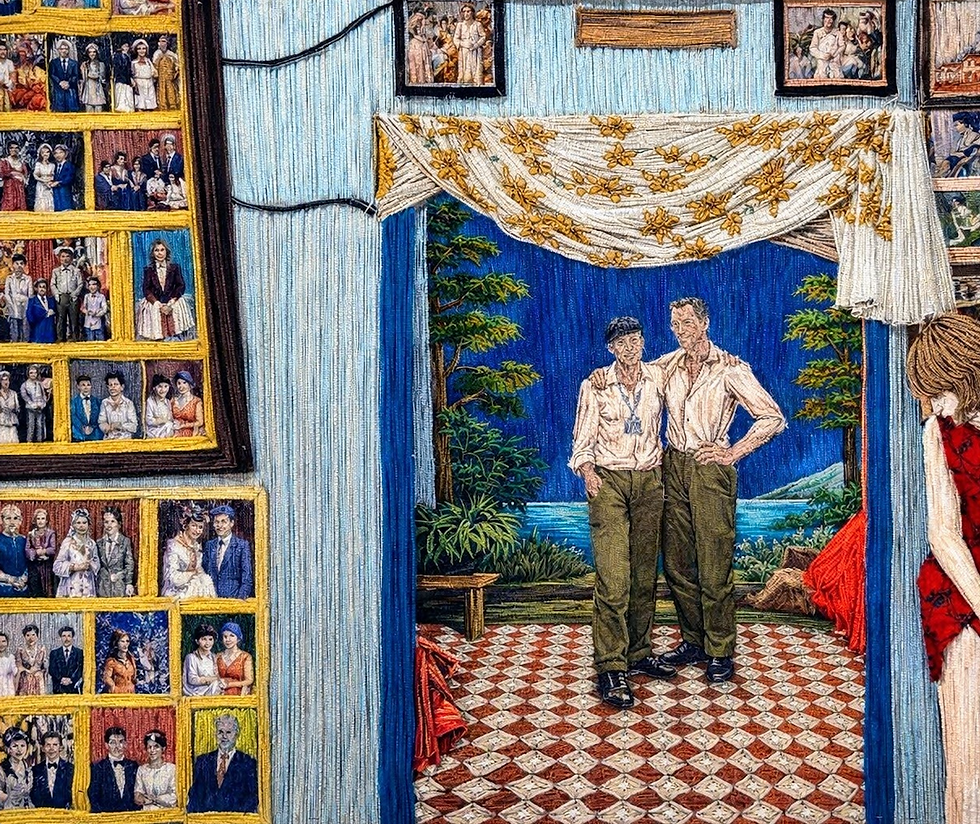
Pelda Aytaş shows what that stage looks like in practice, with no implication that anything is amiss. Gülden Bostancı, the Antalya gallery that lists her among its artists, showed her embroidery on cloth on its stand at CI Bloom in İstanbul in April 2025, weeks before presenting her debut solo exhibition, Naaile, in Antalya. A fair stand and a first solo show are instruments for introducing a painter to collectors who have not yet seen the work — the reverse of a list that holds collectors back. Across most of the contemporary art market at this stage, a gallery's effort runs toward building a first circle of collectors, and a waiting list, where one eventually appears, is a late consequence of that work rather than its starting point.
What This Does Not Tell You
None of this establishes that a waiting list is a meaningless signal, only that it is a narrow and unverifiable one: a claim with one source and no record. A collector cannot confirm that a list exists, how long it is or where any name sits on it, because the only source is the gallery that keeps it, and a list mentioned in a fair aisle carries no more weight than any other unrecorded claim. It cannot show whether demand at the gallery price would survive a public test: a list counts collectors willing to buy at a figure held deliberately below what demand might bear, which is a different thing from collectors willing to bid above it in a saleroom, a distinction taken up in What Does It Mean When an Emerging Artist Appears at Auction? Nor does it settle whether the figure a collector is eventually offered is reasonable, a separate question addressed in How Do You Value an Emerging Artist's Work? Queues also move with the cycle: the thinner client base dealers reported for 2025 could lengthen them again in a stronger year as quickly as a weaker one appears to have shortened them. The harder question is what happens to a list when the restricted works bought in the last boom reach the end of their holding periods, and whether the collectors who waited for them decide to keep what they were given.
Collector's Arch holds no gallery, auction house, art school or artist relationships, and earns nothing from any transaction discussed here.
Market Notes carries new artist analyses and market observations like this one, sent only when there is something worth saying.